The History of Bingo
The game in your community hall has a long family tree, from 16th-century Italy to a carnival near Atlanta.
 Make bingo cards
Classic numbers or your own words, with a caller sheet.
Open the tool →
Early roots
A lottery game called lotto was played in Italy by about 1530. In 18th-century Naples a home version called Tombola added cards, tokens and called numbers. The French game Le Lotto appeared in 1778 with a grid of three rows and nine columns, which led to the card layout we know.
The American game
In the early 1920s Hugh J. Ward standardized a version of the game at carnivals around Pittsburgh, and he published a rule book in 1933. In December 1929, the toy merchandiser Edwin S. Lowe saw people playing a game called Beano at a carnival near Atlanta. He took it to New York. During the Great Depression it spread, and Catholic churches used it for fundraising. By the 1940s bingo was played across the US.
The name
Nobody knows for certain where the name comes from. One story says a player shouted it by mistake instead of "Beano".
The standard card
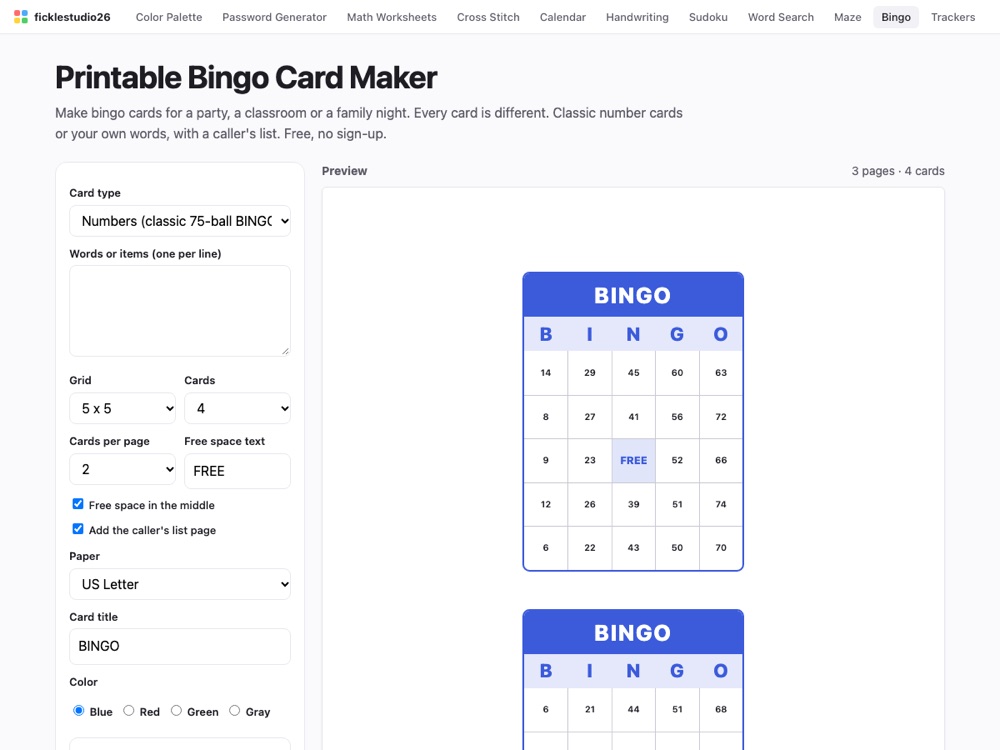
The American 75-ball card is a 5×5 grid with the letters B, I, N, G, O over the columns and a free space in the center. The columns use these number ranges: B 1–15, I 16–30, N 31–45, G 46–60, O 61–75.
More about the early games
Le Lotto, the French game of 1778, used a card of 27 squares in three rows and nine columns. In 19th-century Germany a similar game was used to teach children spelling, animal names and the multiplication table, so the card game was an educational tool long before it was a fundraiser.
From carnivals to church halls
After Hugh J. Ward standardized the game around Pittsburgh in the early 1920s and copyrighted it with a rule book in 1933, the game grew through the Great Depression, helped by churches that ran it as a fundraiser. Where the word "bingo" came from is not known, and it may date from the mid-1920s.
Card variety
A standard 75-ball card has 25 squares in five rows and columns with a free center space, and a win is a completed row, column or diagonal. Special games use other patterns, such as the four corners, a 2×2 "postage stamp," a roving "L," or a full-card "blackout." Reference sources give about 5.52 × 10²⁶ possible cards under the standard rules, so a printable generator can make a different card for every player. The British version is different: a card with three rows of five numbers.
Bingo in the classroom
The same card can hold vocabulary words, math facts, pictures or tasks instead of numbers. Make the call list and the cards from one word list, check that no two cards are identical, and keep a caller sheet so you can verify a win. This also works at parties, with a theme of your choice.
Technology
An electronic bingo system with a large flashboard was designed by Mark L. Gitlin in 1977.
Make bingo cardsClassic numbers or your own words, with a caller sheet.
Open the tool →
Sources
Checked on October 25, 2026. We summarize in our own words and only state what these sources support.
- Wikipedia: Bingo (American version) — history and card layout
- Wikipedia: Bingo (American version) — Le Lotto, Ward, card count, patterns and electronic systems